Ross Hill Wines
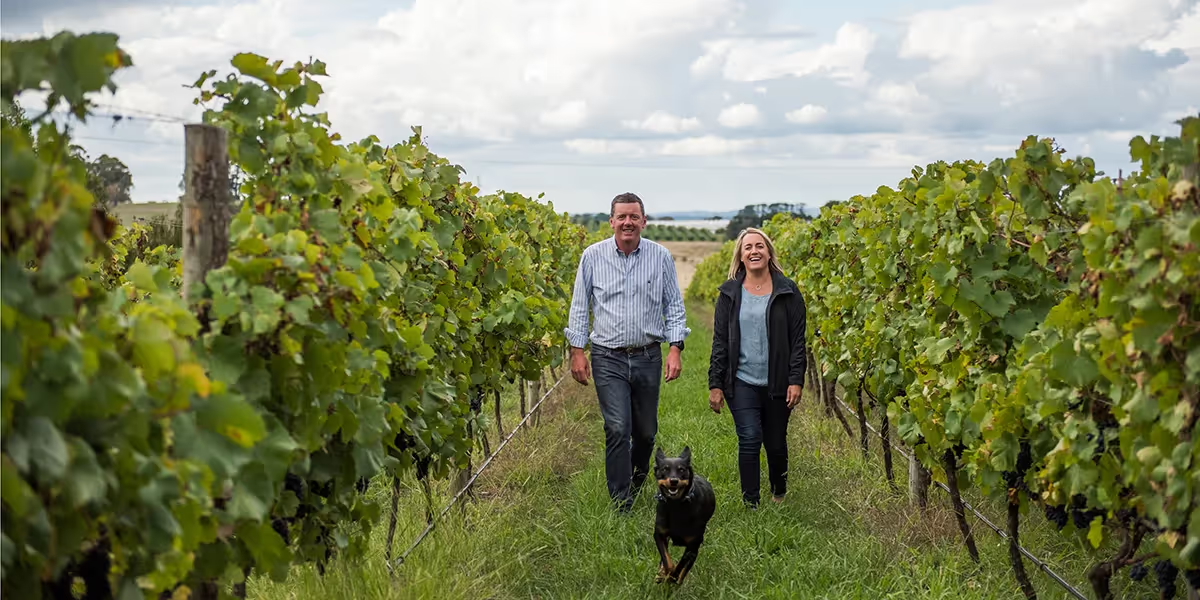

Ross Hill Wines became the first Australian winery to achieve Climate Active carbon neutral certification across both its operations and products.
Date Published: 07/2016
Ross Hill Wines has achieved carbon neutral certification under the Australian Government’s Climate Active program for both its operations and its products. With support from Pangolin, Ross Hill became the first Australian winery to reach this milestone across both organisational and product boundaries.
Climate Active remains Australia’s only government-recognised certification for carbon neutrality, providing a credible framework for organisations seeking to measure, reduce and offset their emissions.
The Winery
Ross Hill Wines produces a range of cool-climate red and white varieties from its vineyard in Orange, New South Wales. Located at 1,018 metres above sea level, the five-hectare site sits on fertile volcanic basalt soil. The majority of grapes are grown on-site, supporting a highly integrated production approach.
Established in 1994 by Peter and Terri Robson, the winery continues to operate as a family business, now involving the next generation alongside its winemaking team. From its early years, Ross Hill has recognised the importance of protecting land productivity and responding to environmental challenges facing the agricultural sector.
Sustainability Initiatives
Ross Hill has implemented a range of practical sustainability initiatives to reduce its environmental impact and improve operational efficiency, including:
- Transitioning to pesticide-free production.
- Introducing natural wild yeast in place of chemical inputs.
- Mulching cover crops to improve soil health and reduce irrigation demand.
- Improving recycling practices, particularly for glass and packaging materials.
- Installing a 34 kW solar photovoltaic system.
- Adopting more efficient cold stabilisation techniques.
- Streamlining freight and distribution processes.
Measuring and Managing Emissions
Ross Hill has taken a staged approach to understanding and managing its environmental impact:
- 2011: Initial assessment of energy use and costs.
- 2013: Completion of a New South Wales Government-supported energy audit, followed by implementation of recommended improvements.
- 2013 to 2014: Engagement of Pangolin Associates to conduct a comprehensive greenhouse gas assessment, resulting in carbon neutral certification for operations.
- 2014 to 2015: Completion of a Life Cycle Assessment to extend certification to all products, starting with the 2015 vintage.
Life Cycle Assessment Approach
Pangolin Associates conducted a hybrid life cycle assessment to support Ross Hill’s Climate Active certification. This approach combined detailed material data with input-output analysis to capture the full emissions profile.
The assessment followed a cradle-to-grave methodology, covering growing, production, packaging and distribution. Using a representative product approach, emissions were assessed across all scopes:
- Scope 1: Transport and stationary fuels, contributing 16.9 per cent.
- Scope 2: Electricity, contributing 2.3 per cent.
- Scope 3: Upstream and downstream activities, including glass bottles, barrels, packaging, freight, business travel and waste, contributing 80.8 per cent.
Following emission reduction activities, total product emissions were calculated at 547.5 tonnes of carbon dioxide equivalent.
Achieving Carbon Neutrality
Ross Hill offset residual emissions totalling 548 tonnes of carbon dioxide equivalent to achieve carbon neutrality. Pangolin Associates supported this process through the procurement and management of certified carbon credits aligned with Climate Active requirements.
These offsets support a renewable energy project in Tamil Nadu, India, contributing to global emissions reduction while meeting rigorous certification standards.
Business Outcomes
Ross Hill’s approach has delivered measurable operational and commercial benefits:
- Reduced Energy Costs: Energy expenditure decreased by more than 75 per cent between 2010 and 2014, supported by efficiency improvements and solar installation.
- Stronger Market Positioning: Carbon neutral certification enhances brand credibility and supports participation in increasingly sustainability-focused supply chains.
- Improved Resilience: A structured approach to emissions management strengthens long-term operational sustainability.
Practical Model for Regional Businesses
Ross Hill demonstrates that small and regional organisations can take a structured and credible approach to climate action. Its dual certification for operations and products highlights the value of integrating sustainability into core business processes. By measuring emissions, implementing targeted reductions and achieving certification, Ross Hill has strengthened both environmental outcomes and commercial performance. Its experience provides a practical example for other organisations seeking to take meaningful action on climate while building long-term value.
75%
Energy expenditure decreased by more than 75 per cent between 2010 and 2014, supported by efficiency improvements and solar installation.
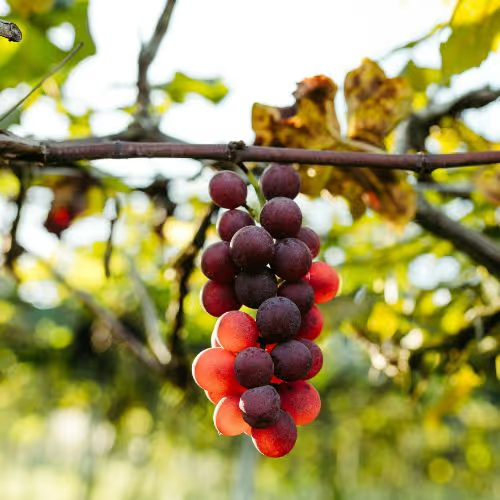
548 tCO₂
Ross Hill offset residual emissions totalling 548 tonnes of carbon dioxide equivalent to achieve carbon neutrality.

Ross Hill has become the first certified carbon neutral (Climate Active) winery in Australia. This has been achieved by the hard work and experience from the team at Pangolin Associates. To become carbon neutral has been a goal for the Robson Family for a long time, our philosophy is to basically have as small a footprint on the earth as possible. With a 38KW solar panel and then energy reduction strategies we have been able to achieve our goal. It would not have been possible with out Pangolin who have been very passionate and diligent in their advice and also steering us through the regulations of becoming carbon neutral.
James Robson
James Robson, Owner, Ross Hill Wines
Request a call back
We welcome your enquiries about sustainability and carbon management.
Follow us on LinkedIn


























.avif)















Industry Expertise, Shaped by Real-World Experience