Strategise
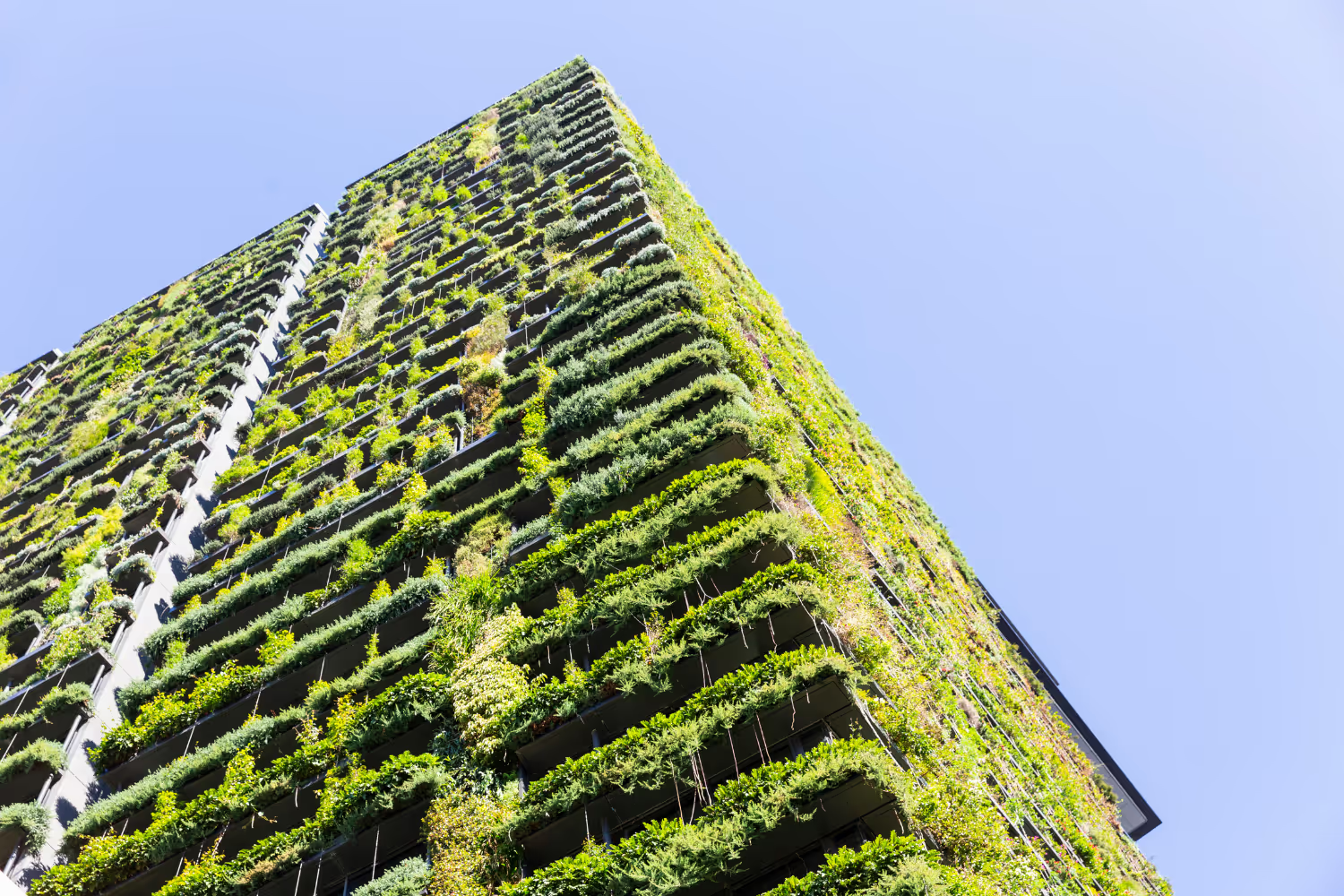
Define decarbonisation targets and assess climate-related risks and opportunities.
In this stage, we help organisations assess climate-related risks and opportunities, understand the impacts of climate change on their operations, and identify pathways to reduce emissions. These insights inform climate transition plans that align with business objectives and support effective decarbonisation.
Climate Scenario Analysis & Risk Evaluation
We conduct climate-related risk assessments aligned with AASB S2, evaluating organisations' exposure to physical and transition risks across a range of climate scenarios and time horizons. Climate scenario analysis helps identify material financial impacts, areas of vulnerability and strategic implications, supporting transparent, decision-ready disclosures and strengthening organisational resilience in a changing climate.
Climate Transition Plans
We develop organisation-wide climate transition plans that set science-based targets and outline practical pathways to decarbonisation. This includes identifying opportunities across energy efficiency, electrification, renewable energy, supply chains and climate adaptation to support long-term business resilience.
Modelling the Financial Impact of Decarbonisation Pathways
We assess and compare the financial implications of different decarbonisation pathways, helping organisations identify cost-effective opportunities and prioritise investment. By modelling costs, returns, avoided carbon liabilities and key sensitivities, we support informed and defensible decision-making.
ESG Strategy
We help organisations develop ESG strategies that align sustainability objectives with business priorities. Informed by a materiality assessment, these strategies support risk management, regulatory compliance, operational performance, and long-term value creation, while strengthening engagement with investors, customers, employees, and other stakeholders.
Safeguard Mechanism Business Integration Strategy
We help organisations navigate Australia's Safeguard Mechanism by developing practical compliance and decarbonisation strategies. This includes emissions forecasting, baseline management, ACCU and safeguard credit assessments, and aligning compliance requirements with business objectives, capital planning and emissions reduction targets.
Circular Economy & Sustainable Product Development
We help organisations apply circular economy principles to the design of products, services and business systems. Our approach supports resource efficiency, waste reduction and sustainable product development, helping organisations reduce risk, improve performance and create long-term value.
Climate Adaptation Strategies
We support organisations in developing practical climate adaptation strategies that respond to current and future climate risks. Through climate vulnerability assessments and resilience planning, we help identify priority actions, investment requirements and opportunities to strengthen long-term resilience.
Executive Learning & Climate Workshops
We deliver tailored executive learning programs and climate workshops that build capability across climate risk, decarbonisation, and AASB S2-aligned governance. Our sessions translate complex climate science, regulatory requirements, and strategic considerations into practical insights, enabling leaders to make informed decisions, strengthen disclosures, and support effective climate action.
We also design education programs that help employees understand the organisational importance of climate action and the role they play in achieving climate objectives, supporting the behaviours and practices needed to deliver meaningful change.
Decarbonise Operations
Frequently Asked Questions
Who can help my company develop a net zero strategy?
Our consultants help organisations develop practical net zero and decarbonisation strategies that turn climate commitments into clear, achievable actions. We assess current and future emissions, identify and prioritise reduction opportunities, and develop a roadmap that brings together targets, initiatives and implementation actions. This can include energy efficiency, electrification, renewable energy and supply chain engagement, with pathways developed for both near-term and long-term climate targets.
How do physical and transition risks differ?
Physical risks arise from the direct impacts of climate change, such as extreme weather events or long-term changes in temperature and sea levels, that can damage assets and disrupt operations. Physical risks can be acute or chronic. Meanwhile, transition risks stem from the shift to a low‑carbon economy, including policy changes, market shifts, technology developments, and reputational pressures that can affect financial performance. Climate scenarios provide a structured way to explore how these physical and transition risks could evolve under different plausible futures.
What is the difference between circular economy and linear economy?
The circular economy provides an alternative to the prevalent “take–make–waste” approach of the linear economy, in which the production of goods depletes natural resources, exacerbates social inequality, and generates waste that is not reintegrated into the production cycle.
By contrast, the circular economy delivers meaningful benefits by reducing waste through smarter product design. This approach extends product lifespans, encourages the sustainable use of natural resources, supports recycling, and prevents waste and pollution. We work with you to identify key circular economy metrics and assess baseline performance, helping to uncover improvement opportunities across your value chain.
What makes a decarbonisation plan investment-ready?
Selecting the optimal pathway requires treating decarbonisation as a capital allocation decision, evaluating cash flows, risks, delivery constraints, and market dynamics with the same discipline applied to any major investment. This involves undertaking financial modelling of decarbonisation pathways, assessing them against key valuation metrics, stress-testing critical variables, and applying a capital markets lens that reflects the organisation’s risk appetite, balance sheet capacity, and cost of capital.
Do you provide AASB S2 training?
Yes, we provide tailored AASB S2 training and executive learning workshops designed to help organisations understand and respond to evolving climate reporting requirements.
For example, in anticipation of reporting requirements, Griffith University engaged Pangolin Associates to help build cross-organisational awareness and alignment across emerging areas such as climate scenario analysis, Scope 3 emissions, and climate-related risk and opportunity disclosure.
Why is climate scenario analysis critical for AASB S2?
Climate scenario analysis is critical for AASB S2 because it enables organisations to assess how different climate futures may affect their strategy, financial position, and business resilience. It also supports the informed disclosure of material climate-related risks and opportunities by providing forward-looking, decision-useful insights.
Request a call back
We welcome your enquiries about sustainability and carbon management.
Follow us on LinkedIn











Industry Expertise, Shaped by Real-World Experience